Lack of Fusion in Welding: Why a Good-Looking Bead Can Still Fail
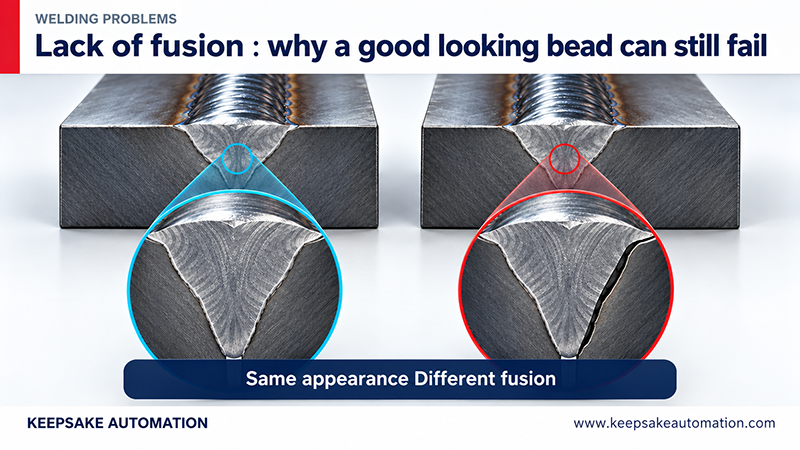
In modern industrial manufacturing, visual inspection alone can be dangerously deceiving. A weld bead can present a smooth, uniform profile while concealing a critical structural defect beneath the surface.
The reality is straightforward: a visually pristine weld is not inherently a structurally sound weld.
While external bead geometry indicates proper metal deposition, weld integrity hinges on metallurgical fusion: the complete bonding of the weld pool with the base material, joint sidewalls, and preceding passes.
For engineering leads and plant managers deploying automated welding systems, navigating this distinction is vital. Uniform aesthetics are a baseline expectation, but true process reliability requires a system engineered to consistently guarantee joint fusion at depth.
What Is Lack of Fusion?
Lack of fusion (LOF) occurs when the deposited weld metal fails to form a continuous metallurgical bond with the base metal or adjoining weld passes.
During the welding cycle, the arc energy must adequately melt the joint interface while the molten pool wets and fuses with the substrate prior to solidification. If thermal input or arc positioning is insufficient, an unfused boundary remains encapsulated within the joint.
Because the molten filler metal often bridges the top of the joint, it creates the superficial appearance of a complete, defect-free weld while masking an internal planar discontinuity.
Why Can the Bead Look Right When Fusion Is Incomplete?
Weld appearance primarily reflects fluid dynamics, surface tension, and solidification at the top of the pool. In contrast, fusion depends on thermal energy delivery directly at the root and sidewall interfaces.
Key operational variables frequently cause a divergence between bead appearance and joint fusion:
1. Torch Vectoring and Arc Directivity
Torch angle determines arc force distribution. If the arc skews slightly off-axis, one sidewall may experience insufficient thermal soaking to breach its melting threshold, leading to cold lapping despite a centered surface bead.
2. Excessive Travel Speed
High travel speeds restrict thermal dwell time across the joint profile. While this produces narrow, clean beads, it often prevents the weld pool from properly wetting the root or sidewalls.
3. Ineffective Weaving Dynamics
Weaving distributes filler metal across wide gaps, but surface coverage does not equal penetration. Without correct arc positioning and sufficient dwell time at the sidewall limits, the molten pool simply washes over cold base metal without fusing.
4. Joint Fit-Up and Geometric Variance
Inconsistent root gaps, tight bevel angles, or excessive root faces mechanically block the arc from reaching the joint root, preventing direct energy transfer where fusion is needed most.
5. Surface Contamination
Mill scale, oxides, oil, and rust form thermal and chemical barriers. Without proper joint preparation, the arc energy is wasted melting surface contaminants rather than bonding base materials.
Why Automation Alone Does Not Guarantee Weld Quality
Robotic welding offers exceptional repeatability, path precision, and duty cycles. However, a robot will execute an incorrect process with absolute perfection.
If torch angles, weave parameters, or travel speeds are suboptimal, an automated system will consistently replicate lack-of-fusion defects across every part. Furthermore, upstream component tolerances, thermal distortion, or fixture wear can shift the physical joint off the programmed path.
This highlights the critical difference between process repeatability and process capability:
-
Repeatability: The ability of the equipment to execute the exact same mechanical path and parameter set repeatedly.
-
Capability: The ability of the entire cell configuration to produce welds that consistently meet non-destructive testing (NDT) acceptance criteria under real-world production variances.
Achieving true quality in automated welding requires a holistic approach, integrating precision fixturing, adaptive seam tracking, real-time arc monitoring, and robust cell integration.
Heat Input: Optimization Over Pure Power
When addressing lack of fusion, a common instinct is to simply increase amperage or voltage. However, higher heat input is rarely a blanket solution.
Excessive heat input introduces severe downstream failure modes, including thermal distortion, oversized heat-affected zones (HAZ), grain growth, and burn-through.
The objective is energy targeting, not energy escalation. Corrective action requires balancing wire feed speed, voltage, travel speed, and torch geometry to concentrate thermal energy precisely where fusion is missing.
Detecting and Preventing Lack of Fusion
Preventing LOF requires shifting from reactive defect inspection to proactive process control:
-
Upstream Joint Audit: Enforce strict tolerances on joint prep, bevel geometry, root gaps, and surface cleanliness prior to welding.
-
Path and Vector Verification: Validate real-time torch-to-joint orientation, ensuring arc force is vectoring into joint corners rather than riding the molten pool.
-
Procedure Qualification: Verify that welding procedure specifications (WPS) are validated under actual production conditions, accounting for heat sink effects in heavy plate or complex geometries.
-
Targeted Inspection Protocol: Visual testing (VT) cannot detect subsurface LOF. Utilize appropriate Non-Destructive Testing (NDT) methods, such as Phased Array Ultrasonic Testing (PAUT) or Radiographic Testing (RT), tailored to the joint geometry and flaw orientation.
Building Quality Into the Process
In high-throughput automated manufacturing, quality cannot be inspected into a part after the fact; it must be built into the process design.
When subsurface defects occur, the solution isn’t just grinding and re-welding; it’s auditing the system parameters, fixturing rigidity, and torch trajectories that allowed the defect to form in the first place.
Building robust controls directly into automated systems allows manufacturers to maintain tight tolerances and avoid hidden discontinuities across long production runs. When every element of the welding ecosystem is aligned, from joint design to robotic execution, process capability naturally follows.
The Bottom Line
A smooth, consistent weld bead is desirable, but appearance alone cannot establish adequate fusion.
Reliable welding requires the right combination of joint preparation, torch orientation, process parameters, motion control, and inspection.
For automated welding, the goal is not simply to reproduce the same bead on every component. It is to reproduce a process that consistently meets the required quality standards, because consistency matters only when the underlying process is correct.
By shifting focus from superficial appearance to deep process validation, manufacturing engineering teams can eliminate hidden risks, optimize cycle times, and guarantee structural performance across every completed assembly.